A Dying Woman Asked the Hospital to Call a Man She Loved Once — When He Arrived, a Child and a Truth He Never Expected Changed Everything
The desert highway stretched endlessly beneath a bruised Arizona sky, its heat shimmering like a mirage, as the low thunder of motorcycle engines rolled forward in disciplined formation, cutting through the late afternoon silence with the kind of authority only men who had nothing left to lose could carry. At the front rode Caleb “Stone” Wilder, a man whose name alone still commanded respect in outlaw circles long after most assumed he had retired into the anonymity of age, his steel-gray beard tugged by the wind, his eyes fixed on the horizon as if motion itself were the only thing keeping his past from catching him.
At sixty-nine, Caleb no longer rode for adrenaline or rebellion, but because the open road was the last place where his thoughts didn’t turn inward, didn’t remind him of the choices he had buried beneath decades of asphalt and smoke, choices that were never meant to surface again.
Then his phone rang.
The vibration against his chest felt invasive, wrong, like a knock on a door that should have remained sealed forever, and he ignored it at first, letting it buzz until instinct told him this call wasn’t ordinary, that whatever waited on the other end wasn’t going to leave him alone.
He pulled onto the shoulder, gravel crunching beneath heavy tires, lifted the phone, and answered with irritation sharp enough to cut steel.
“Speak.”
“This is Desert Ridge Medical Center,” a woman said, her voice calm but unmistakably strained. “I’m calling for Mr. Caleb Wilder.”
His jaw tightened. “You found him. Now tell me why.”
There was a pause, the kind loaded with weight.
“A woman has been admitted following a major accident,” the nurse continued. “She is in critical condition. She has been asking for you repeatedly. She insisted we contact you.”
Caleb exhaled sharply. “You’ve got the wrong man.”
“No,” she said gently. “She didn’t give us your name at first. She described you. The tattoos. The bike. The scar on your left shoulder. She said you would know it was her.”
The desert suddenly felt cold.
Caleb closed his eyes.
“Her name is Marisol Vega,” the nurse added quietly. “And before she lost consciousness, she said something else. She said you’re the father of her son.”
The world didn’t stop spinning, but something inside Caleb did.
Father.

The word echoed with brutal force, hitting places he had armored long ago, places he told himself were dead and gone, because a man like him didn’t get to be anyone’s anchor, didn’t get to leave behind anything soft or living.
“That’s not possible,” he muttered, though his voice betrayed him.
“She also said,” the nurse continued, “that her son is here. He’s three years old. And he’s been waiting.”
Caleb didn’t respond. He didn’t say goodbye. He ended the call and sat there, hands gripping the handlebars so tightly the leather creaked beneath his fingers, the sun dipping low as memories he never allowed himself to revisit rose up uninvited, sharp and undeniable.
Marisol’s laugh. Her defiance. The night she disappeared without a word.
Without explaining anything to his crew, Caleb turned his bike back onto the highway, twisting the throttle until the engine screamed, riding not toward escape, but straight into the truth he had outrun for years.
The hospital was too clean, too white, too quiet, and Caleb felt every inch the outsider as he walked through automatic doors that whispered shut behind him like a final warning. Nurses glanced up from their stations, their eyes lingering on his weathered face and leather vest, curiosity mixing with judgment, but no one stopped him.
A woman in blue scrubs approached, her expression softened with professional empathy.
“Mr. Wilder,” she said. “I’m Nurse Collins. Thank you for coming.”
“I didn’t come,” Caleb replied gruffly. “I was summoned.”
She nodded, as if she understood more than she let on. “Please follow me.”
The hallway smelled of antiseptic and fear, and each step forward felt heavier than the last, until they reached a room partially shielded by drawn curtains and the steady mechanical beeping of machines keeping time with a fragile heartbeat.
Before stepping inside, Nurse Collins placed a gentle hand on his arm.
“I need to prepare you,” she said softly. “She’s been through significant trauma.”
Caleb said nothing.
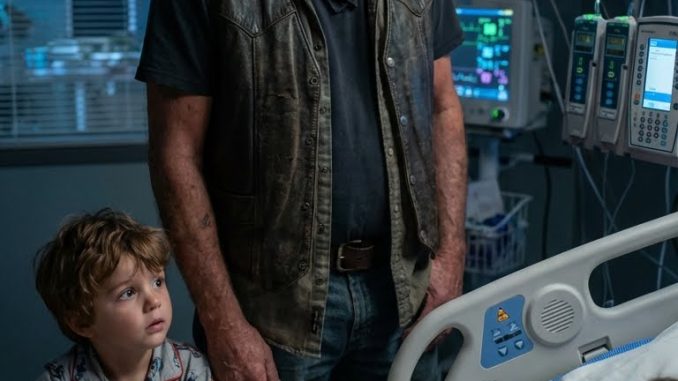
Inside, the past lay broken beneath sterile lights.
Marisol’s face was swollen, bruised beyond recognition in places, her dark hair tangled against the pillow, tubes and wires tracing paths across her body like a map of survival, but beneath it all, she was unmistakably her.
And then Caleb saw him.
A small boy stood beside the bed, clutching the rail with both hands, his tiny shoulders squared in defiance against a world already asking too much of him, his wide brown eyes lifting to meet Caleb’s with a calm curiosity that stole the breath from his lungs.
Those eyes were his.
Not metaphorically.
Literally.
The nurse spoke quietly behind him. “His name is Leo.”
The name landed like a memory unlocked.
Marisol had once whispered it years ago under a sky full of stars, joking, dreaming, imagining a future Caleb had never believed he deserved.
Leo didn’t cry. He didn’t hide.
He simply looked at Caleb, as if some instinct recognized what logic could not.
Caleb took a step forward, then another, knees weak, heart pounding with a rhythm he didn’t recognize, until he stood beside the bed, staring at the woman he loved once, the child he never knew existed, and the life he unknowingly abandoned.
A doctor later explained the injuries, the prognosis, the uncertainty, but Caleb heard only fragments, his attention anchored to the small hand gripping Marisol’s fingers, to the way Leo leaned protectively against her bed as if his presence alone might keep her alive.
“She never told me,” Caleb said hoarsely once the doctor left. “Why wouldn’t she tell me?”
Nurse Collins hesitated. “She said you were running. And she didn’t want to be the reason you stopped living the only way you knew how.”
That truth hurt more than accusation ever could.
Hours passed.
Then came the night.
Marisol stirred, her eyes fluttering open briefly, pain etched into every movement, and when she saw Caleb, tears slid silently down her temples.
“You came,” she whispered.
“I’m here,” he said, gripping the bedrail to steady himself.
She smiled faintly. “Good. Then I can say it.”
Her breathing hitched. Machines beeped faster.
Caleb leaned closer.
“He’s not just yours,” she whispered. “He’s… not biologically yours.”
The room tilted.
“What?” Caleb breathed.
Marisol’s eyes held his, unwavering even as life slipped through her fingers. “Leo’s father died before he was born. You’re not his blood. But you’re the man I trusted most. The man I knew would show up if it mattered.”
Caleb’s mind reeled.
“I put your name on nothing,” she continued weakly. “But I taught him about you. About loyalty. About strength. About choosing love even when it scares you.”
Her fingers tightened around his.
“I need you to be his father,” she said. “Not because you made him. But because you’re the only one who can protect him.”
The machines screamed.
Doctors rushed in.
Caleb was pushed back, frozen, watching as chaos swallowed the room.
Minutes later, silence fell.
Marisol Vega was gone.
Leo stood in the hallway clutching a toy motorcycle, oblivious to the permanence of loss, while Caleb sat against the wall, a man undone, realizing that fatherhood was never about blood, but about staying when every instinct tells you to run.
Child Protective Services came.
Paperwork followed.
Questions about his past, his lifestyle, his capacity to care for a child.
Caleb answered them all honestly.
“I’m not perfect,” he said. “I’ve made mistakes that’ll follow me forever. But I won’t abandon him. I won’t let him grow up wondering why he wasn’t enough.”
That night, Leo slept on Caleb’s chest in a small, unfamiliar apartment cleared of empty bottles and ghosts, his tiny heartbeat grounding a man who had never known stillness could feel like purpose.
Years later, the Black Mesa Riders would still roar down desert highways, but Caleb rode less often now, because some roads are meant to end, and some lives are meant to begin quietly, in bedtime stories, scraped knees, and the steady presence of someone who finally learned that love isn’t a chain — it’s an anchor.
Lesson of the Story
True responsibility doesn’t come from biology, legality, or obligation; it comes from choosing to stay when leaving would be easier, from loving without guarantees, and from understanding that redemption isn’t found on the open road, but in the quiet moments where another life learns it is safe because you showed up.
Leave a Reply