No one noticed the girl at first.
That was the way it always was.
She sat quietly in her wheelchair at the edge of the crowded emergency shelter, her small hands folded in her lap, her dark hair tied back with a faded ribbon. Around her, voices overlapped—volunteers shouting instructions, radios crackling, boots scraping against concrete floors. Fear had a sound, and it filled the room.
The sign above the door read TEMPORARY SHELTER, but nothing about the place felt temporary. People carried everything they had left in plastic bags. Some stared at nothing. Some cried openly. Others didn’t cry at all, which was somehow worse.
The girl’s name was Lily.
She was eleven years old, and she had not walked since the accident.
At the far end of the shelter, separated by a metal gate and a thick yellow warning sign, lay the reason several people refused to come any farther inside.
A retired military K9.
His name was Rex.
Once, Rex had been a legend.
He had served in war zones most people only saw on the news. He had sniffed out explosives, pulled wounded soldiers from fire, and stood between danger and humans without hesitation. But that was before the injury. Before the explosion that damaged his hearing. Before the panic attacks. Before the reports started using words like unstable and unpredictable.
Now, the paperwork called him “unfit for public interaction.”
The whispers were harsher.
“Too dangerous.”
“Time bomb.”
“Put him down already.”
Rex lay still, his gray muzzle resting on his paws, amber eyes half-lidded but alert. Every sound made his muscles tighten. Every sudden movement earned a low, warning growl. The volunteers kept their distance. Even trained handlers refused to approach without heavy sedation.
Everyone agreed on one thing:
No one should go near that dog.
Except Lily didn’t know that.
Or maybe she did—and went anyway.
Her wheelchair made a soft, uneven sound as she rolled closer to the gated area. A volunteer noticed too late.
“Hey—stop! You can’t—!”
The words came out sharp, panicked.
Rex’s head lifted.
The room seemed to inhale all at once.
Hands reached for radios. Someone swore under their breath. A handler stepped forward, heart pounding, already imagining the report he’d have to write if this went wrong.
But Lily didn’t stop.
She rolled right up to the gate and looked at Rex—not with fear, not with curiosity, but with recognition. The kind you have when you see someone who understands pain the way you do.
“Hi,” she said softly.
Her voice barely carried.
Rex didn’t growl.
That alone was strange enough to make people pause.
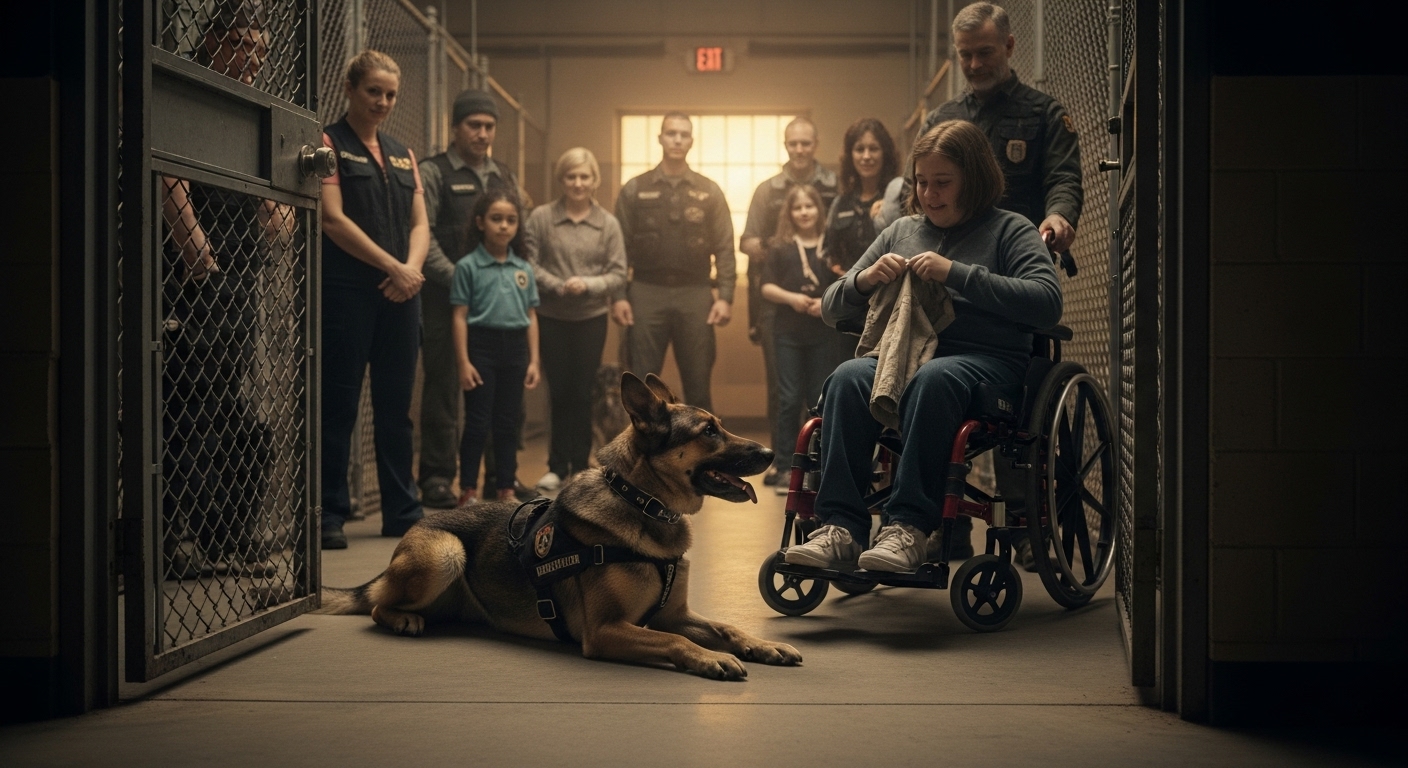
Lily reached into her pocket and pulled out something small: a worn piece of fabric, frayed at the edges.
“My dad was a handler,” she said, still talking to the dog. “He used to say dogs remember things people forget.”
The handler froze.
Rex’s ears twitched.
Lily lifted the fabric and held it toward the gate.
It smelled like dust, metal, and old uniforms.
Rex stood up.
Gasps rippled through the shelter.
Slowly—carefully—he walked forward. His steps were hesitant, unsure, like a soldier returning to a battlefield after the war was over.
He pressed his nose against the gate.
Then he did something no one had seen him do in years.
He sat.
Perfect posture. Straight back. Calm eyes.
A command response.
But no command had been given.
Lily smiled, tears slipping down her cheeks.
“You remembered,” she whispered.
Rex let out a low, gentle whine—not fear, not aggression, but something closer to grief. He lowered his head until his forehead rested against the cold metal gate, directly in front of Lily.
The shelter fell completely silent.
No radios.
No footsteps.
No breathing loud enough to hear.
A dog everyone had written off as broken was choosing trust.
A child everyone overlooked was being seen.
One of the handlers slowly unlocked the gate.
No one stopped him.
Rex didn’t move toward Lily.
Instead, he lay down at her feet, placing his body between her and the rest of the room—just like he had done for soldiers years ago.
Protecting.
Waiting.
Standing guard.
In that moment, everyone understood something they had forgotten:
Danger isn’t always what looks scary.
And healing doesn’t always come from the people we expect.
Sometimes, it comes quietly—
on four tired legs—
when a broken hero finally recognizes someone just like himself.